
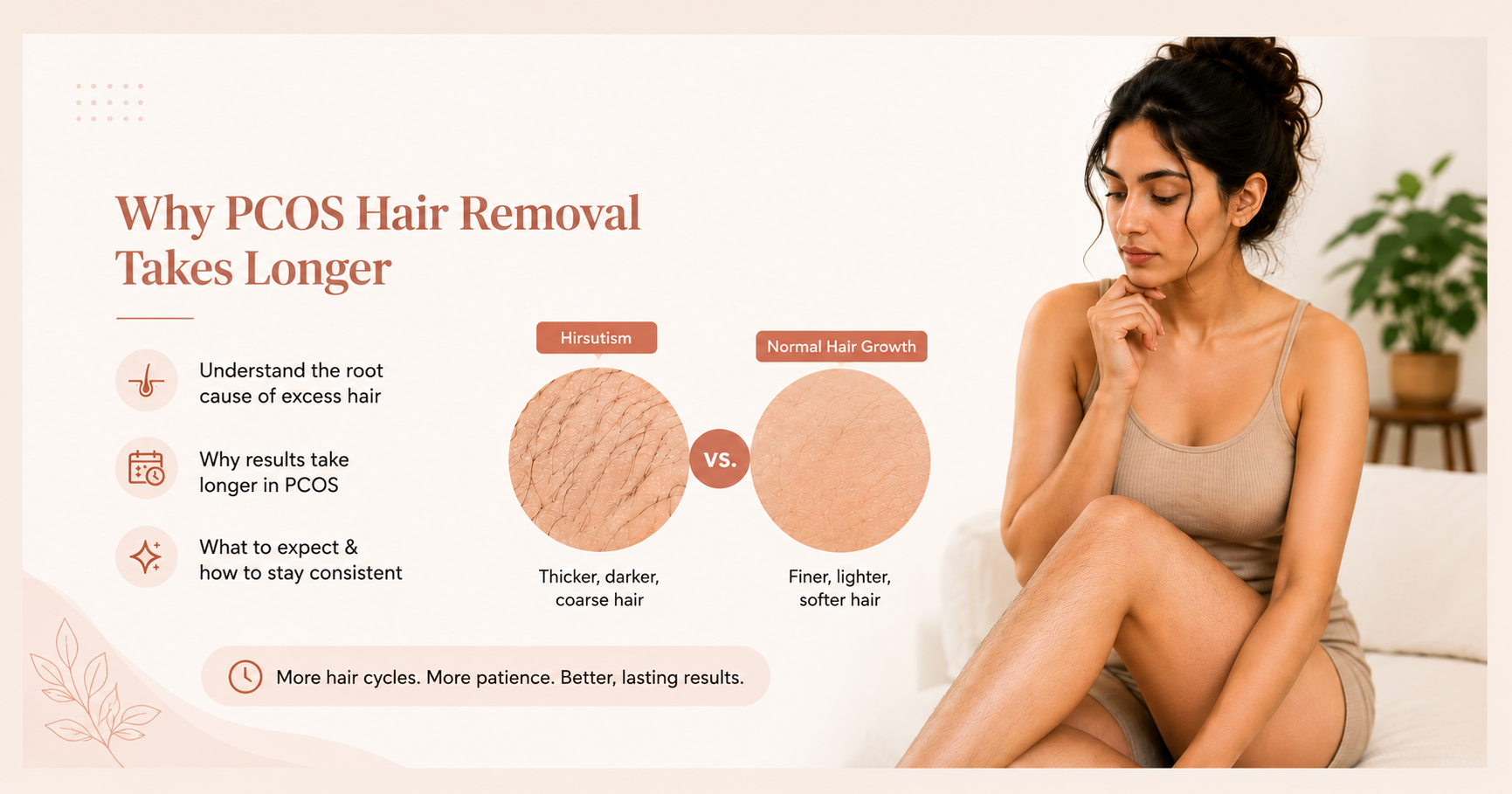
If you've ever felt like your hair removal routine "should" be working faster, you're not imagining things — hormonal hair genuinely behaves differently. Here's what's actually going on, and why it changes how you should approach hair removal.
What Is Hirsutism?
Hirsutism is the medical term for excess hair growth in a male-pattern distribution — think chin, upper lip, chest, lower abdomen — driven by elevated androgen levels. It's one of the most common symptoms of PCOS and PCOD, affecting a large share of people with these conditions.
Why It's Different From Regular Hair
Regular body hair follows a fairly predictable growth cycle. Hormonal hair, on the other hand, is under continuous stimulation from androgens, which means:
- It grows back thicker and coarser over time, rather than staying consistent
- New follicles can be activated that weren't previously producing visible hair
- The growth cycle itself shifts, often spending more time in active growth phases
This is exactly why generic hair removal advice — "just wax it" or "shaving is fine" — tends to fall short. These methods don't address the underlying stimulation, and in some cases (like shaving) can make hair feel coarser as it grows back, which several of our customers with PCOD have specifically mentioned experiencing before switching to IPL.
What This Means for Your Routine
- Consistency beats intensity. Regular, scheduled sessions (many of our PCOS/PCOD customers use IPL twice a week) tend to outperform sporadic, high-intensity ones.
- Facial hair needs more patience than body hair. This shows up consistently in customer feedback — body hair often responds within the first few uses, while facial hair takes longer to visibly thin.
- Track progress over months, not weeks. Because androgens keep the growth cycle active, meaningful reduction is a gradual process.
The Bottom Line
Hormonal hair isn't a sign that hair removal "isn't working" for you — it's a different biological process that needs a different approach: consistent treatment, realistic timelines, and — ideally — a device built with sensitive, higher-frequency use in mind.
Curious whether IPL is right for your specific situation? [Read our full PCOS/PCOD hair removal guide] or message us on WhatsApp with questions.
Share:
IPL Hair Removal for PCOS & PCOD: What to Really Expect
IPL Hair Removal and PCOS: Your Questions Answered